
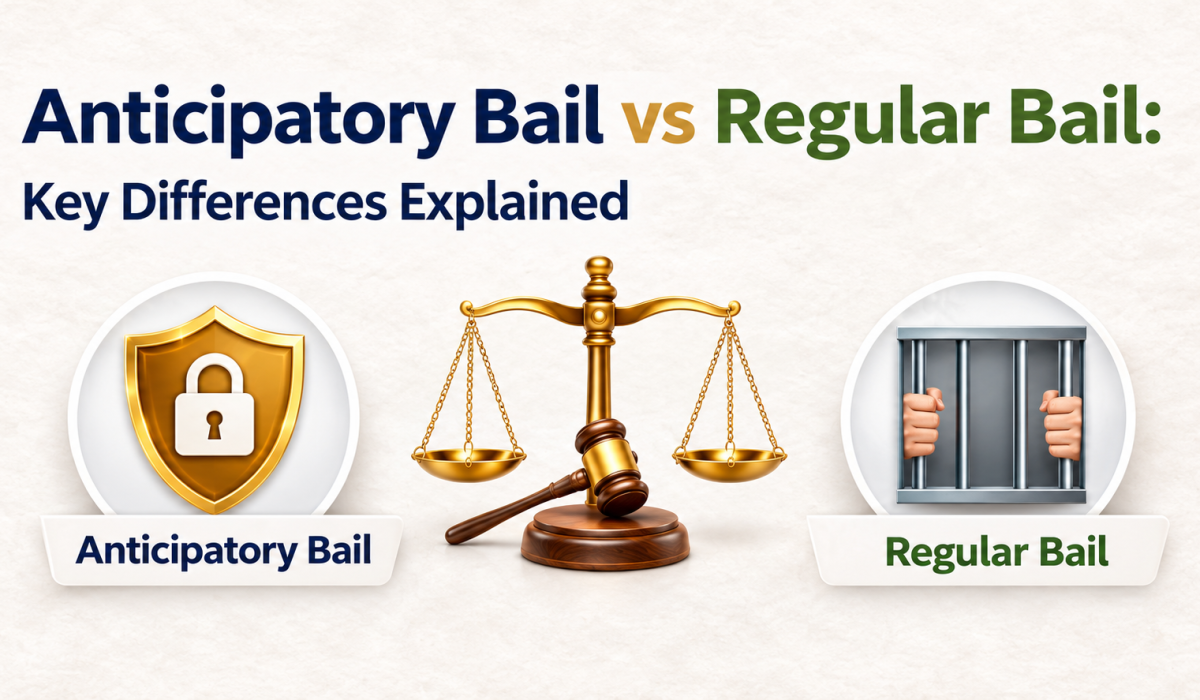
Anticipatory Bail: Meaning, Legal Provisions and Application Process in India
What Is Anticipatory Bail?
Anticipatory Bail is a form of pre-arrest legal protection available to a person who has reason to believe that they may be arrested in connection with an accusation of committing a non-bailable offence. It allows the person to approach the competent court for an order directing that they be released on bail if the specified arrest occurs.
In India, Anticipatory Bail is governed by Section 482 of the Bharatiya Nagarik Suraksha Sanhita, 2023 (BNSS), which replaced Section 438 of the Code of Criminal Procedure, 1973, subject to the applicable transitional provisions.
The purpose of Anticipatory Bail is to protect individual liberty while ensuring that investigations and criminal proceedings can continue in accordance with the law. Granting such relief is a judicial decision based on the facts, allegations, available material and applicable legal principles.
An application for Anticipatory Bail does not automatically prevent arrest. Protection generally depends on the court passing an appropriate order and the person complying with its conditions.
Legal Provisions Governing Anticipatory Bail in India
Section 482 of the Bharatiya Nagarik Suraksha Sanhita, 2023
Section 482 BNSS empowers the High Court or the Court of Session to grant a direction for bail to a person who apprehends arrest on an accusation of committing a non-bailable offence.
The court may consider the circumstances of the case and impose appropriate conditions. These may include:
- Making oneself available for police interrogation when required.
- Not threatening, influencing or inducing witnesses.
- Not leaving India without the court’s prior permission.
- Complying with other lawful conditions imposed by the court.
The court evaluates the application according to the relevant facts and legal principles. The nature of the allegations, the material available, the person’s circumstances and the requirements of a fair investigation may be relevant to the decision.
Section 482 also contains specific statutory exclusions for certain offences under Sections 65 and 70(2) of the Bharatiya Nyaya Sanhita, 2023. The applicability of these exclusions must be assessed carefully in the context of the allegations and current law.
Difference Between Section 438 CrPC and Section 482 BNSS
Section 438 of the former Code of Criminal Procedure, 1973 dealt with directions for anticipatory bail. Under the new criminal procedure framework, the corresponding provision is Section 482 of the BNSS.
For offences and proceedings involving transitional questions, the date of the alleged offence and the applicable savings provisions may need to be considered. Legal advice can help identify the correct statutory framework.
Who Can Apply for Anticipatory Bail?
A person who has a reasonable basis to apprehend arrest for a non-bailable offence may consider applying for Anticipatory Bail, subject to statutory restrictions.
Applications may arise in cases involving allegations such as:
- Cheating and financial fraud.
- Criminal breach of trust.
- Property-related criminal allegations.
- Certain matrimonial and dowry-related offences.
- Business and commercial disputes involving alleged criminal conduct.
- Other offences for which pre-arrest bail is legally available.
The fact that an offence appears in this list does not mean that Anticipatory Bail will necessarily be available or granted. Special legislation may impose restrictions, and the particular allegations and circumstances must be examined.
Grounds Considered by the Court
There is no single formula that guarantees Anticipatory Bail. Courts consider the circumstances of each application and the applicable judicial principles.
Nature and Seriousness of the Allegations
The court may examine the nature of the alleged offence, the specific role attributed to the applicant and the material presented in support of the accusation.
Possibility of Cooperation With the Investigation
The applicant’s willingness and ability to cooperate with lawful investigative requirements may be relevant. Anticipatory Bail does not ordinarily remove the obligation to participate in the investigation as directed.
Risk of Interference With Evidence
The court may consider whether there is a reasonable concern that the applicant could threaten witnesses, influence relevant persons or interfere with evidence.
Personal Circumstances
Relevant personal circumstances and the surrounding facts may be considered where legally appropriate. No individual factor automatically determines the outcome.
Need for Custodial Interrogation
The investigating agency may present reasons why custodial interrogation is considered necessary. The court assesses such submissions alongside the applicant’s arguments and the applicable law.
The weight given to each consideration depends on the case. An application should be supported by accurate facts and relevant legal grounds rather than unsupported assertions.
How to Apply for Anticipatory Bail in India
The procedure depends on the circumstances, the applicable law and the court approached. A typical application may involve the following steps.
Step 1: Obtain Legal Advice
The applicant should consult a qualified criminal lawyer to review the allegations, available documents and the possibility of arrest. The lawyer can identify relevant statutory provisions and any special restrictions.
Step 2: Review the Case Details
Relevant material may include a copy of the FIR, complaint, police notice, communications, supporting documents and other information concerning the alleged offence. The exact documents required depend on the case.
Step 3: Prepare the Application
The application generally explains the circumstances giving rise to the apprehension of arrest, the applicant’s position, relevant facts and the legal grounds for seeking protection.
The application must comply with the procedural requirements of the competent court.
Step 4: File Before the Competent Court
An application may be filed before the Court of Session or the High Court, as permitted by Section 482 BNSS and the applicable procedural rules. The appropriate forum and filing requirements should be confirmed for the specific matter.
Step 5: Attend the Hearing
The court may hear submissions from the applicant’s lawyer and the prosecution. Depending on the circumstances, it may consider the case diary or other relevant material available through the lawful process.
Step 6: Comply With the Court’s Order
If Anticipatory Bail is granted, the applicant must comply with all conditions imposed by the court. These may concern investigation, attendance, travel or other matters relevant to the case.
The grant of Anticipatory Bail is not a finding that the applicant is innocent, nor does it terminate the investigation or criminal proceedings.
Documents That May Be Required
The documents needed for an Anticipatory Bail application vary according to the case and court requirements. Commonly relevant material may include:
- A copy of the FIR or complaint, where available.
- The applicant’s identification and relevant personal details.
- A copy of any police notice or communication.
- Documents supporting the applicant’s account of the events.
- Relevant correspondence, contracts or transaction records.
- Previous court orders, if any.
- Other documents that support the legal grounds raised in the application.
The lawyer should verify the current filing requirements and ensure that the application contains accurate information.
What Happens After Anticipatory Bail Is Granted?
When the competent court grants Anticipatory Bail, the order provides protection in accordance with its terms. If the applicant is subsequently arrested on the accusation covered by the order, the statutory mechanism requires release on bail upon compliance with the applicable requirements.
The applicant may still be required to attend questioning, cooperate with the investigation and comply with other court-imposed conditions.
Failure to comply with conditions or other legally relevant circumstances may lead to proceedings concerning cancellation or modification of bail, where permitted by law.
An Anticipatory Bail order should be read carefully because its scope, duration, conditions and application to particular proceedings depend on the wording of the order and applicable legal principles.
Can Anticipatory Bail Be Rejected?
Yes. A court may reject an Anticipatory Bail application after considering the facts, the allegations, the applicable law and the submissions of the parties.
Depending on the circumstances, the applicant may seek an appropriate remedy before a higher court, subject to the law and procedural requirements. A further application must not be based on misleading information or an attempt to conceal material facts.
If an application is rejected, the person should obtain prompt legal advice about the next steps and the risk of arrest. The legal consequences depend on the circumstances and any other orders in force.
Importance of Legal Representation in Anticipatory Bail Matters
Anticipatory Bail proceedings may require a careful understanding of criminal procedure, judicial decisions, statutory restrictions and the facts of the alleged offence.
A criminal lawyer may assist with:
- Reviewing the allegations and available evidence.
- Identifying the appropriate court and legal provisions.
- Preparing the application and supporting documents.
- Presenting relevant legal grounds at the hearing.
- Responding to prosecution objections.
- Advising on compliance with conditions imposed by the court.
- Assessing available legal remedies if relief is refused.
Effective representation requires a truthful presentation of the facts and a realistic assessment of the legal position. No lawyer can guarantee that Anticipatory Bail will be granted.
Frequently Asked Questions About Anticipatory Bail
What is the meaning of Anticipatory Bail?
Anticipatory Bail is pre-arrest legal protection that a competent court may grant to a person who reasonably apprehends arrest for a non-bailable offence, subject to the applicable law and conditions.
Which section governs Anticipatory Bail in India?
Section 482 of the Bharatiya Nagarik Suraksha Sanhita, 2023 governs Anticipatory Bail under the current criminal procedure framework, subject to applicable transitional provisions and statutory exclusions.
Can Anticipatory Bail be filed before an FIR is registered?
The availability of relief depends on the circumstances and whether there is a reasonable basis to apprehend arrest on an accusation of a non-bailable offence. The absence of an FIR does not, by itself, resolve the question. A lawyer should assess the specific facts and applicable judicial principles.
Is Anticipatory Bail available in every criminal case?
No. It is not automatically available in every case. Statutory exclusions and restrictions under special legislation may apply, and the court must assess the circumstances.
Does Anticipatory Bail mean that the case is closed?
No. Anticipatory Bail concerns protection against arrest under the applicable order. The investigation and criminal proceedings may continue.
Can the court impose conditions while granting Anticipatory Bail?
Yes. Section 482 BNSS permits the court to impose appropriate conditions, including cooperation with interrogation, restrictions on influencing witnesses and travel restrictions where applicable.
What should a person do if Anticipatory Bail is refused?
The person should promptly consult a qualified criminal lawyer to assess available remedies, relevant court orders and the risk of arrest. The appropriate next step depends on the facts and applicable law.
Conclusion
Anticipatory Bail is an important legal remedy for individuals who reasonably apprehend arrest in connection with a non-bailable offence. Section 482 of the Bharatiya Nagarik Suraksha Sanhita, 2023 establishes the current statutory framework, subject to its exclusions and other applicable legal restrictions.
Understanding the allegations, preparing accurate supporting documents and presenting appropriate legal grounds can help a court assess the application. Anyone facing a potential arrest should seek timely advice from a qualified criminal lawyer and comply with all lawful directions issued by the court or investigating authorities.